
IT Equipment Is Constantly Processing Data Hall Air
Data centre fan failures in servers, storage systems and other critical IT equipment are usually treated as an equipment maintenance issue.
But when failures become repetitive, particularly across multiple pieces of equipment within the same Data Hall, another question should be considered:
Could environmental contamination be contributing to the problem?
That air does not simply pass around the equipment. It is actively drawn through fan assemblies, filters where fitted, heatsinks and other internal components.
Any particulate suspended in the Data Hall air therefore has the opportunity to enter the equipment.
Over time, contamination can accumulate on fan blades and housings, air intake grilles, filters, heatsinks, internal surfaces, power supplies, electronic assemblies and restricted airflow paths.
The important point is that the cooling system of the IT equipment can effectively become a particulate collection system.
During cleaning, I initially believed these cooling fan covers had a black powder-coated finish. It was only when vacuuming began that the underlying silver surface was revealed. What appeared to be the original finish was actually a substantial layer of deposited contamination.
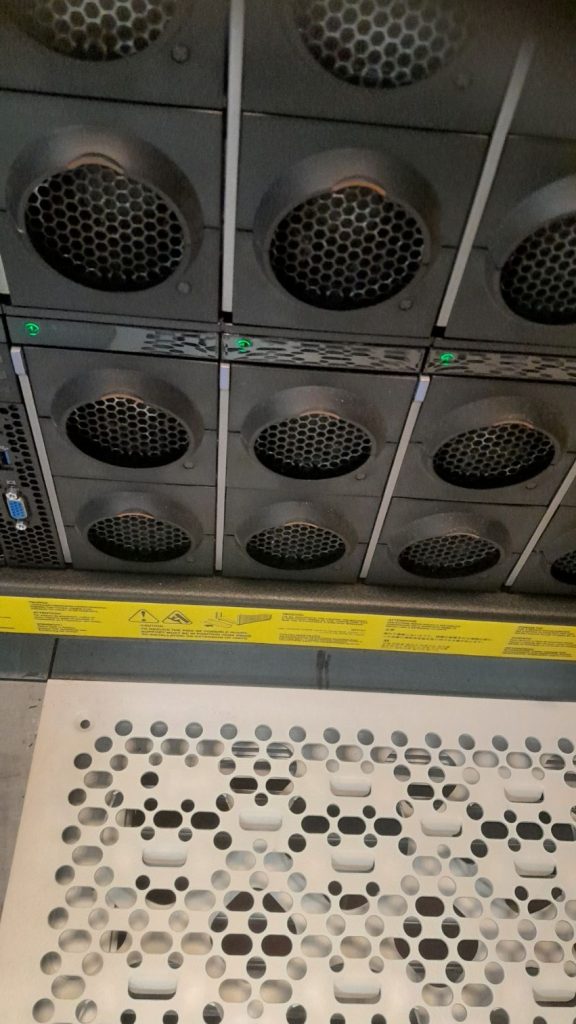
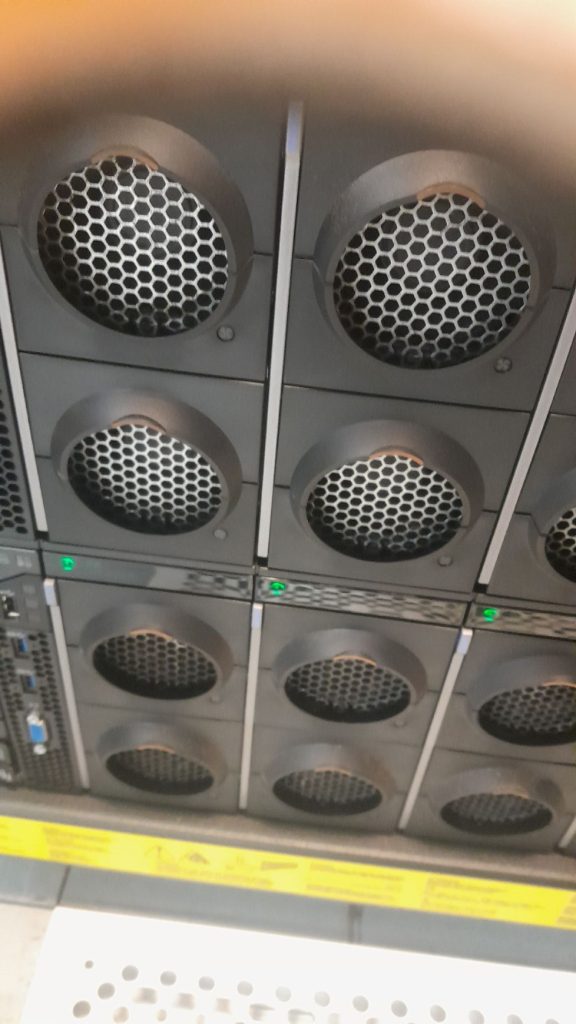
How Airborne Contamination Can Affect Server Cooling Fans
Deposited particulate does not automatically mean that a fan will fail.
However, contamination can create conditions capable of increasing the mechanical and thermal demands placed on cooling systems.
Accumulation on fan blades may affect aerodynamic performance or contribute to imbalance. Restricted filters, heatsinks and airflow passages can increase resistance to airflow.
Where cooling performance deteriorates, equipment control systems may respond by increasing fan speed to maintain the required internal temperature.
The potential sequence is:
Airborne particulate → deposition → restricted or inefficient airflow → increased fan demand → increased mechanical loading and energy consumption → accelerated wear.
This does not prove that contamination caused a particular fan failure.
It does, however, make environmental contamination a factor worth investigating when unexplained or repeated cooling-component failures occur.
What Particle Sizes Matter in a Data Centre?
Visible dust represents only part of the contamination present within a Data Hall.
Fine particles measured in micrometres (µm) may remain airborne for considerable periods and be transported throughout the environment by cooling airflow.
ISO 14644-1 provides a recognised method of classifying airborne particulate cleanliness within controlled environments.
For technical IT environments, IT Cleaning Ltd commonly measures airborne particulate at 0.5 µm, 1.0 µm and 5.0 µm, providing a broader picture of the particulate present within the environment. Where ISO 14644-1 classification is required, the applicable particle-size concentration limits are assessed in accordance with the Standard.
Particles at these sizes may not be readily visible to the human eye.
This is why visual inspection alone cannot establish the airborne cleanliness condition of a Data Hall.
“It looks clean” is not a measurement.
Where Does Data Centre Contamination Come From?
Even an enclosed Data Hall can generate or receive particulate contamination.
Potential sources include:
- Building and refurbishment works
- Personnel movement
- Packaging materials and cardboard
- Floor and ceiling systems
- Cable installation
- Poorly controlled access
- External air ingress
- Mechanical wear within cooling equipment
One source we have encountered during Data Hall cleaning is black particulate generated by the wear of CRAC/ACU drive belts.
Once released, particulate can be distributed throughout the environment by the cooling system and ultimately drawn through operating IT equipment.
This means the contamination source may not be immediately adjacent to the affected server or rack.
Investigate Before Assuming
If equipment suppliers or maintenance engineers begin reporting unusual numbers of fan failures, the first response should not necessarily be:
“The Data Hall needs cleaning.”
The better response is:
“Let’s establish the environmental condition first.”
An investigation can include inspection of equipment air intakes and exhausts, fan assemblies and visible deposits, cabinets and surrounding surfaces, CRAC/ACU units, floor voids and overhead areas.
Recent construction or refurbishment activity should also be considered.
This physical investigation can then be supported by airborne particulate measurement.
The objective is to obtain evidence before remedial work is recommended.
Airborne Particle Testing in Data Centres
Portable particle counters allow the concentration and distribution of airborne particulate to be assessed across the Data Hall.
Testing at multiple locations across the Data Hall can help establish the distribution of airborne particulate and identify areas where concentrations may be elevated.
Results can then be assessed against the required environmental cleanliness specification, including where applicable ISO 14644-1 Class 8.
This changes the conversation from:
“Does the Data Hall look dusty?”
to:
“What is actually present in the air being drawn through the IT equipment?”
That is a much more useful question when investigating equipment reliability.
Why Cleaning Should Be Followed by Particle Testing
Where excessive contamination is identified and technical cleaning is required, the process should not finish when the surfaces look clean.
Cleaning removes deposited contamination.
Airborne particle testing provides measurable evidence of the airborne particulate cleanliness achieved following cleaning.
For this reason, IT Cleaning Ltd combines specialist Data Hall cleaning with airborne particulate testing and can provide a detailed report and certificate following completion.
The objective is not simply to make the Data Hall look cleaner.
It is to establish a controlled technical environment where both deposited and airborne particulate contamination are understood and managed.
Data Centre Fan Failures: Correlation Is Not Causation
This distinction is important.
Finding contamination inside equipment that has experienced fan failures does not automatically prove that the contamination caused those failures.
Fan assemblies can fail for many reasons, including component age, bearing wear, manufacturing defects, electrical faults, operating temperature and normal mechanical deterioration.
But environmental contamination should not be dismissed simply because other failure mechanisms exist.
Where repeated data centre fan failures occur, particularly across equipment operating within the same environment, contamination should be treated as one potential contributing factor and investigated accordingly.
Measure First. Diagnose. Then Act.
Data Centres increasingly rely on high-density computing platforms where cooling performance is critical to reliability and energy efficiency.
Understanding the particulate cleanliness of the air being processed by that equipment should therefore form part of contamination-control and reliability management.
If unexplained data centre fan failures are occurring, don’t rely solely on what the Data Hall looks like.
Inspect the equipment.
Investigate the contamination sources.
Measure the airborne particulate.
Then decide what action is required.
Because when equipment is moving thousands of litres of Data Hall air through itself every hour, what is suspended in that air matters.