
Particulate Ingress: – When Energy Efficiency Introduces a Contamination Risk.
Economised air conditioning can significantly reduce the energy required to cool a data centre. By taking advantage of suitable external ambient conditions, an economiser can reduce the amount of mechanical refrigeration required and improve overall cooling efficiency.
However, where outside air is introduced directly into the Data Hall, another factor needs to be considered:
Particulate contamination.
The outside atmosphere is not a controlled environment. Depending on location, weather conditions and nearby activity, external air can contain a complex mixture of fine particulate matter capable of entering the Data Hall through the ventilation system.
For facilities operating high-density, mission-critical or AI infrastructure, contamination control should therefore form part of the design, operation and maintenance of any air-side economisation strategy.
What Can Be Brought into the Data Hall?
Outdoor air can contain particles from numerous sources, including:
- Road traffic and tyre/brake wear
- Construction and demolition activity
- Soil and mineral dust
- Industrial emissions
- Diesel exhaust
- Pollen and biological material
- Smoke and combustion particles
- Coastal salts in certain locations
The contamination load can also change dramatically throughout the day. A construction project starting nearby, increased road traffic, dry windy weather or an external pollution event can alter the particulate concentration entering the cooling system.
The Data Hall may therefore be exposed to a contamination source that is both variable and largely outside the operator’s control.
Filtration Is Critical
The effectiveness of an economised cooling system as a contamination barrier depends heavily on its filtration system.
Filters do not simply either “stop dust” or “allow dust through”. Their efficiency varies according to particle size, filter classification, condition, installation and airflow.
Fine particles are particularly important.
Particles that are too small to be readily visible can pass through inadequate filtration and enter the Data Hall airflow. Once inside, they can circulate through server racks and be drawn directly through IT equipment by high-volume cooling fans.
A Data Hall can therefore appear visually clean while still experiencing significant airborne particulate loading.
The IT Equipment Becomes Part of the Filtration System
Modern servers continuously move large quantities of cooling air through their chassis.
If fine particulate contamination is present in the Data Hall air, the server effectively processes that contaminated air continuously.
Some particles pass through. Others deposit on:
- Fan assemblies
- Heat sinks
- PCBs
- Power supplies
- Internal surfaces
- Air intakes and grilles
- Network equipment
Over months or years, relatively low airborne concentrations can result in significant internal accumulation simply because of the enormous volume of air passing through the equipment.
This becomes increasingly important as rack densities and equipment cooling airflow increase.
Deposition Is Not Uniform
Particulate contamination entering through economised cooling will not necessarily settle evenly across the Data Hall.
Airflow patterns can concentrate contamination in particular locations.
Rack configuration, containment systems, pressure differences, supply-air velocity, return-air paths and local turbulence can all influence where particles travel and where they eventually deposit.
This means a visual inspection of one part of a Data Hall may not accurately represent conditions elsewhere.
It is also why simply checking whether the floor “looks dusty” is not an effective contamination-control strategy.
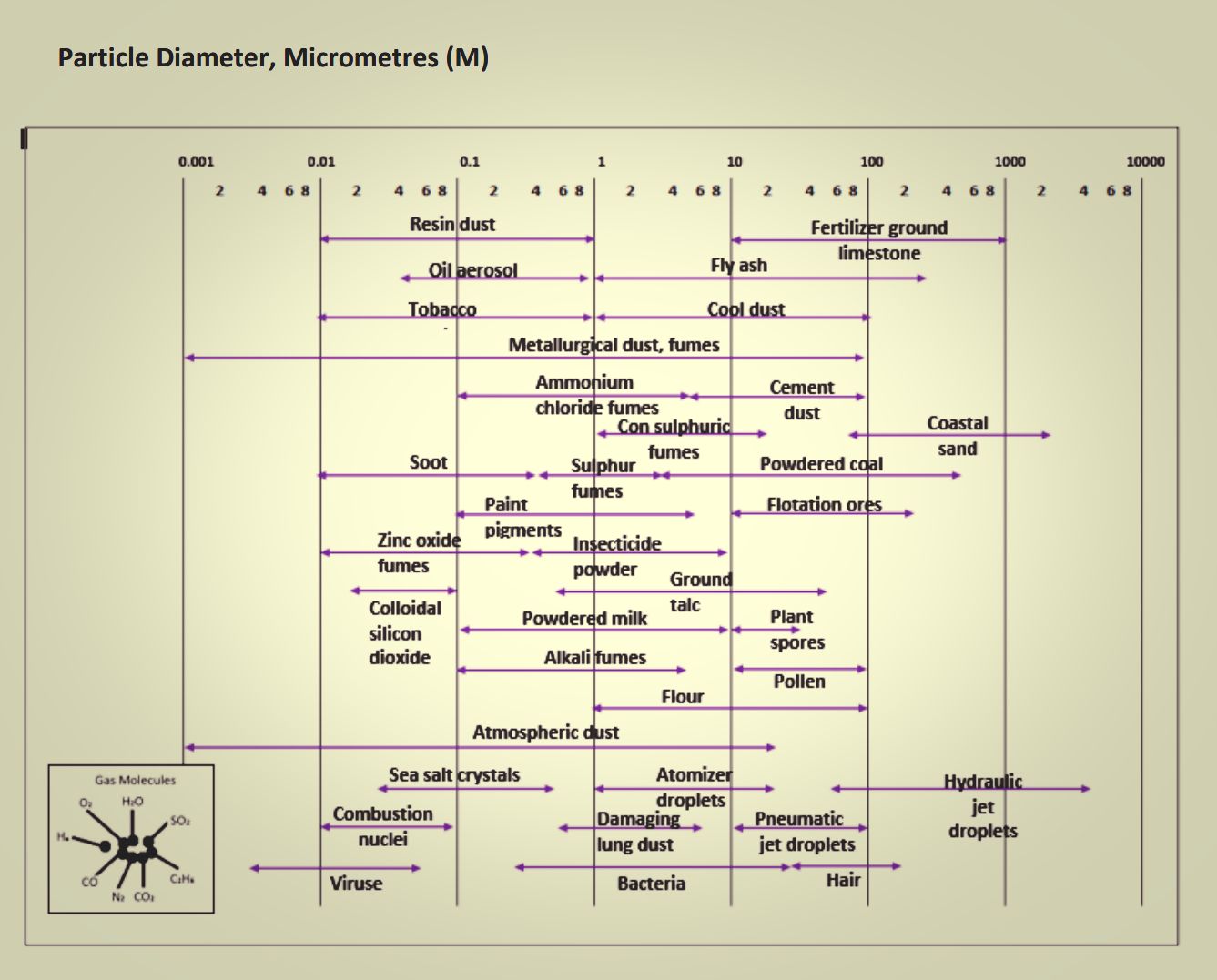
Larger particles are generally easier to capture through filtration and are more likely to settle onto surfaces.
Fine particles behave differently.
They can remain suspended for considerably longer and follow the Data Hall airflow through cooling systems, containment and IT equipment.
The smaller the particle, the less useful normal visual inspection becomes.
This creates an important distinction between:
Visible cleanliness and measured airborne cleanliness.
A Data Hall can look extremely clean while still containing concentrations of fine airborne particulate.
Why This Matters to IT Equipment
Particulate contamination is not simply a housekeeping issue.
Accumulation can potentially contribute to:
Restricted airflow – Deposits on grilles, filters, fans and heat-transfer surfaces can interfere with cooling.
Thermal performance – Contamination on cooling components can reduce effective heat transfer.
Equipment contamination – Fine particles can be transported directly into servers, switches, storage systems and other hardware.
Electrical risk – Certain contaminants become more problematic when combined with humidity, particularly where particles contain conductive, corrosive or hygroscopic material.
Corrosion risk – The chemical composition of contamination can be as important as the quantity present.
The question should therefore not simply be:
“How much dust is there?”
It should also be:
“What is the contamination, where has it come from, and where is it being deposited?”
Economisation Requires Contamination Monitoring
Economised cooling should not automatically be regarded as a contamination problem. Properly designed systems with appropriate filtration and monitoring can provide substantial energy benefits.
The issue arises when energy efficiency is considered without equal attention being given to contamination control.
A sensible strategy should consider:
- External particulate concentrations
- Filtration efficiency and condition
- Pressure differentials
- Filter bypass and sealing
- Data Hall airborne particle concentrations
- Surface contamination
- Internal equipment contamination
- Changes caused by seasonal or local environmental conditions
This is particularly important when nearby construction or demolition activity changes the external environment.
ISO 14644-1 Provides a Measurement Framework
For Data Halls where particulate cleanliness is important, airborne particle measurement provides objective evidence rather than relying solely on visual inspection.
Testing against ISO 14644-1 can establish the airborne particle concentration within the Data Hall and determine whether the environment meets a defined cleanliness classification.
For facilities working toward ISO 14644-1 Class 8, testing can also identify changes in particulate conditions over time.
This can be particularly useful where economised cooling is being used.
Rather than assuming the filtration system is protecting the Data Hall, particle monitoring can help demonstrate what is actually happening within the controlled space.
Establish a Baseline
One of the most useful approaches is to establish a particulate baseline under normal operating conditions.
Particle measurements can then be compared over time and against factors such as:
- Economiser operating mode
- External air quality
- Filter replacement
- Seasonal changes
- Nearby construction
- Changes to cooling configuration
This turns contamination control from a reactive cleaning exercise into a measurable environmental management process.
For critical facilities, continuous particulate monitoring can take this a stage further by identifying abnormal increases before significant contamination accumulates.
Energy Efficiency and Cleanliness Should Work Together
Economised air conditioning can deliver genuine efficiency benefits, but the external air being used for cooling must be treated as a potential contamination pathway.
As Data Halls move towards higher-density computing and increasingly valuable AI and HPC infrastructure, controlling the environment surrounding that equipment becomes increasingly important.
The objective should not be to choose between energy efficiency and particulate control.
It should be to achieve both.
At IT Cleaning Ltd, our approach is to assess contamination through cleaning, airborne particulate measurement and validation, including Data Hall cleaning and testing to ISO 14644-1 Class 8 where required.
If a Data Hall uses economised cooling and there are concerns about particulate ingress, measuring the airborne environment and inspecting where contamination is accumulating can provide a far clearer picture than visual cleanliness alone.