
Airborne particulate monitoring, surface cleanliness and the continuing need for specialist Data Centre cleaning
By Stephen Yates, Managing Director, IT Cleaning Ltd
Introduction
As Data Centres increasingly adopt permanent airborne particulate monitoring, an important question is emerging about ISO Class 8 Data Centre Cleaning: if a Data Hall consistently meets ISO 14644-1 Class 8, does it still need specialist technical cleaning?
The answer depends on more than airborne particle concentrations.
At IT Cleaning Ltd, we recognised this distinction in 2008 and introduced an additional requirement into our technical cleaning specification:
Clean to ISO 14644-1 Class 8, plus all accessible surfaces free from dust.
This requirement arose from practical experience. We repeatedly encountered Data Halls that achieved acceptable airborne particulate concentrations while substantial dust and other contamination remained on equipment and infrastructure.
Nearly two decades later, that distinction is becoming increasingly relevant.
What ISO 14644-1 Actually Measures
ISO 14644-1 establishes air cleanliness classifications based on the concentration of airborne particles at specified particle sizes.
It does not establish whether cabinet tops, cable trays, equipment surfaces or raised-floor voids are free from deposited contamination.
Nor does it identify the chemical composition or origin of airborne particles.
A Data Hall can therefore achieve ISO Class 8 while still containing significant accumulated dust.
Case Study 1: Black Dust from Suspected CRAC Drive-Belt Wear
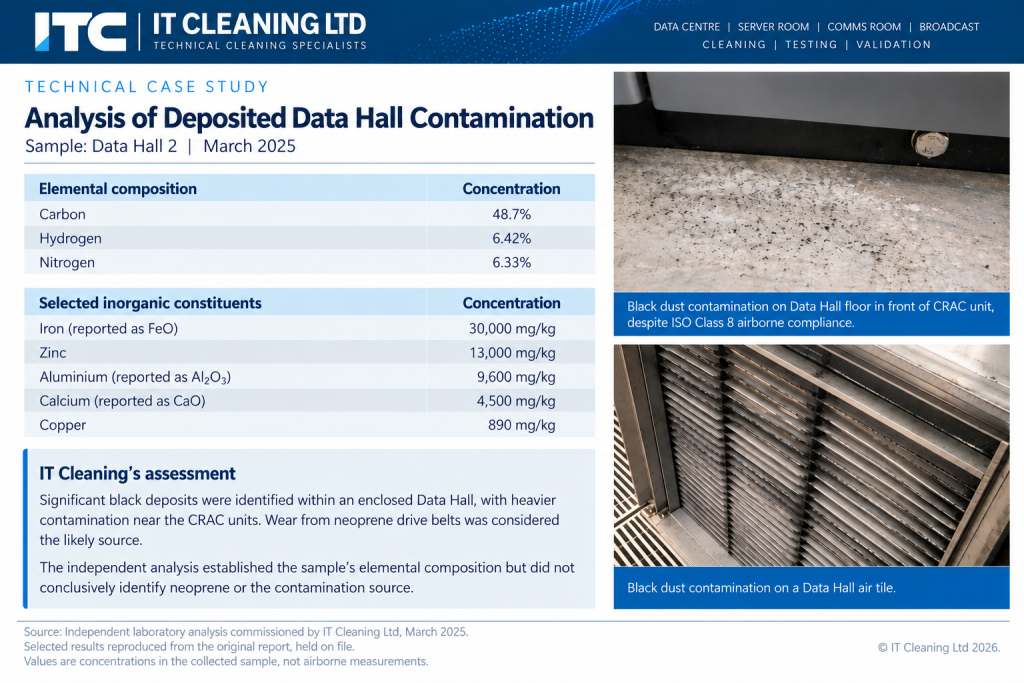
In March 2025, IT Cleaning commissioned independent laboratory analysis of black dust recovered from an enclosed Data Hall that had achieved ISO 14644-1 Class 8 airborne cleanliness.
The analysis identified a carbon content of 48.7%, together with several metallic and mineral constituents.
The contamination was more concentrated around the CRAC units. Wear from neoprene drive belts was considered a possible source, based on the distribution and appearance of the deposits. However, the laboratory analysis did not conclusively identify neoprene or establish the contamination’s origin.
Although the analysis did not conclusively establish the material’s origin, it provided further evidence that significant deposited contamination can exist within a Data Hall despite compliant airborne particulate concentrations.
Case Study 2: External Environmental Contamination
At another Data Centre, outside-air intakes faced a railway station approximately 50 metres away.
This raised questions about the potential introduction of environmental particulate associated with nearby railway operations.
Railway environments can generate particulate from several sources, including braking systems, wheel and rail wear and, where applicable, combustion emissions.
The proximity of the railway station did not independently establish the source of any contamination, but it highlighted the importance of considering external environmental conditions when assessing Data Centre cleanliness.
Case Study 3: Economised Air and Widespread Black Deposits
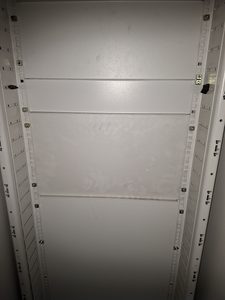
During an October 2026 survey, IT Cleaning identified widespread black, greasy contamination on equipment and accessible surfaces within a Data Hall using economised outside air.
The contamination smeared during wet wiping but could be removed from Perspex surfaces using tack wiping.
Airborne particulate testing was undertaken while the economiser was operational, including at the air inlet and throughout the Data Hall.
All tested locations achieved ISO Class 8 conditions for the measured particle sizes.
Further investigation established that the economiser used MERV 8 inlet filtration and MERV 11 outlet filtration.
Two standby generators were also located on the same side of the building as the economiser intakes. Their exhausts discharged vertically, above the intake level but below roof level.
The generators underwent monthly testing, although it had not yet been established whether their operation coincided with outside-air economisation.
Potential exhaust re-entrainment was therefore identified as an issue warranting investigation, not as a confirmed cause.
The source, composition and age of the deposited contamination remain undetermined.
Nevertheless, the survey demonstrated that airborne compliance and significant deposited contamination can coexist.

The Limitations of Permanent Airborne Monitoring
Permanent airborne particulate monitoring can provide valuable information about changing environmental conditions.
It can help operators identify unusual particulate events, investigate filtration performance and understand airborne cleanliness trends.
However, airborne monitoring does not directly measure the quantity of dust deposited on equipment and infrastructure.
It also cannot necessarily detect every relevant contaminant. Measurement capability depends on the instrument, its particle-size channels and its sampling arrangements.
For example, monitoring beginning at 0.5 µm does not directly quantify smaller particles, some of which may contribute to deposited contamination over time.
Monitoring should therefore be regarded as one component of a wider contamination-control strategy.
Determining how often a Data Hall should be cleaned requires consideration of airborne particulate monitoring, physical surface inspections and the operating environment. Our guide to how often a Data Hall should be cleaned explores these factors in more detail.
Why Surface Contamination Matters
Deposited contamination can accumulate on cooling components, ventilation pathways, electrical equipment and other infrastructure.
Depending on its composition, quantity and location, contamination may contribute to restricted airflow, thermal management problems, corrosion or electrical reliability risks.
Not every visible deposit presents the same risk. The properties of the material and its interaction with the equipment must be considered.
Importantly, satisfactory airborne particle counts do not establish that these surface-related risks are absent.
ISO Class 8 Data Centre Cleaning: A More Complete Approach
IT Cleaning advocates a combination of:
- Airborne particulate monitoring and testing.
- Physical inspection of accessible surfaces and equipment.
- Investigation of potential contamination sources.
- Appropriate specialist technical cleaning.
- Post-clean validation and documented reporting.
- Periodic reassessment to determine future cleaning requirements.
Cleaning frequencies should reflect the operating environment, observed contamination, equipment sensitivity and maintenance history rather than relying exclusively on a fixed interval or airborne monitoring result.
Conclusion
Airborne particulate monitoring is an important development in Data Centre environmental management. It should be encouraged, not dismissed.
But it answers a different question from physical surface inspection.
Airborne compliance does not equal surface cleanliness.
A Data Hall may meet ISO 14644-1 Class 8 while still containing significant deposited contamination requiring investigation or removal.
This is why IT Cleaning Ltd has maintained its additional specification since 2008:
ISO 14644-1 Class 8, plus all accessible surfaces free from dust.
For Data Centre operators, the message is straightforward: monitor the air, inspect the surfaces, investigate contamination sources and clean where the evidence demonstrates a need.
Learn more about IT Cleaning Ltd’s specialist Data Centre Cleaning services, including ISO 14644-1 Class 8 cleaning, airborne particulate testing and post-clean validation.
Technical references
- ISO 14644-1:2015 — Classification of air cleanliness by particle concentration.
- ISO 14644-9:2022 — Assessment of surface cleanliness for particle concentration.
- ISO 14644-17:2021 — Particle deposition rate applications.
- ANSI/ASHRAE Standard 52.2 — Air filter efficiency testing and MERV classification.
- Independent laboratory dust analysis, March 2025 — Technical evidence held on file by IT Cleaning Ltd.
© IT Cleaning Ltd 2026. All case studies anonymised to protect client confidentiality.