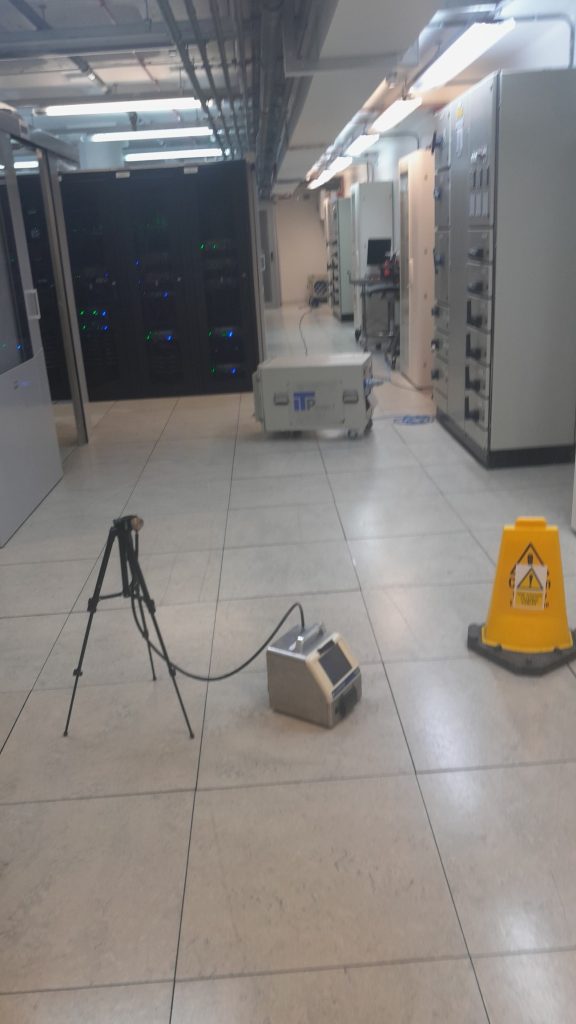
A Data Hall can look clean and still contain levels of particulate contamination capable of entering servers, switches, storage systems and other critical IT equipment. ISO 14644 Class 8 Data Centre Cleaning provides a measurable method of controlling this contamination.
Modern Data Halls move enormous volumes of air. Cooling systems continuously circulate air through the room, while server fans pull that air directly through increasingly dense electronic equipment.
Any particulate contamination present within that airflow therefore has the potential to become an IT equipment contamination problem.
This is why professional Data Hall cleaning should be based on measurable contamination control rather than appearance alone.
One recognised benchmark is ISO 14644-1 Class 8.
Why ISO 14644 Class 8 Data Centre Cleaning Matters
ISO 14644-1 is an internationally recognised standard used to classify the cleanliness of air by airborne particle concentration.
For ISO Class 8, the maximum permitted airborne particle concentrations include:
Particle Size | Maximum Concentration |
≥0.5 µm | 3,520,000 particles/m³ |
≥1.0 µm | 832,000 particles/m³ |
≥5.0 µm | 29,300 particles/m³ |
These concentrations are measured using calibrated airborne particle-counting equipment.
This is fundamentally different from visually inspecting a Data Hall after cleaning.
ISO classification provides measurable evidence of airborne cleanliness.
Why Particulate Contamination Matters in Data Centre Cleaning
Servers and network equipment are effectively high-volume air-processing devices.
Cooling fans continuously draw conditioned Data Hall air through the equipment chassis and across components including:
- Heat sinks
- Printed circuit boards
- Power supplies
- Fans
- Connectors
- Memory
- CPUs and GPUs
- Network interfaces
If contamination is suspended within the Data Hall airflow, some of it will inevitably be drawn through the IT equipment.
Over time, deposited contamination can contribute to restricted airflow, reduced heat-transfer efficiency, blocked filters and heat sinks, fan contamination and increased operating temperatures.
Depending on the type of contaminant and environmental conditions, deposited material may also contribute to electrical and corrosion-related risks.
The Data Hall Floor Is Only Part of the Problem
One of the most common misconceptions is that Data Hall cleaning means cleaning the visible floor.
Contamination can accumulate throughout the environment, including:
- Cabinet tops
- Cable trays
- Floor grilles
- Raised-floor voids
- Structural surfaces
- Cooling equipment
- PDUs
- Walls and ledges
- External equipment surfaces
- Difficult-to-access areas
In raised-floor Data Halls, the floor void can be particularly important.
Where the void is being used as a cold-air supply plenum, contamination beneath the floor is located directly within the cooling airflow.
Dust disturbed within that void can potentially be transported towards floor grilles and into the Data Hall.
Cleaning only the visible floor surface therefore does not necessarily address the contamination source.
Data Hall Contamination Is Constantly Being Generated
Even a well-managed Data Hall is not a sealed cleanroom.
Particulate contamination can be introduced or generated through normal operation.
Typical sources include:
People and clothing
Personnel continuously shed fibres, skin particles and other microscopic material.
Cardboard and packaging
Equipment installation can introduce paper fibres, cardboard dust and packaging debris.
Construction and maintenance
Drilling, cutting, ceiling work and refurbishment can generate very fine particulate contamination.
Cooling equipment
Mechanical components such as drive belts can generate particulate material through wear.
Floor voids
Historical contamination can remain beneath raised floors for years and be redistributed by airflow or maintenance activity.
External air
Where outside air is introduced into the cooling system, external particulate contamination may enter the facility if filtration is insufficient.
The important point is that contamination control is not simply a housekeeping issue.
It is an ongoing operational requirement.
Why Ordinary Commercial Cleaning Is Not Enough
A Data Hall is not an office.
Cleaning methods that are perfectly acceptable in normal commercial environments may be inappropriate around live critical IT infrastructure.
Technical cleaning requires controlled methods designed to remove contamination without creating additional operational risks.
This may include:
- HEPA-filtered vacuum equipment
- Controlled low-moisture wiping
- Anti-static or ESD-conscious cleaning techniques
- Low-residue cleaning chemistry
- Controlled cleaning of cabinets and equipment
- Raised-floor and subfloor cleaning
- Airborne particulate monitoring
- Procedures designed specifically for live technical environments
The objective is not simply to move visible dust.
It is to remove contamination while minimising its redistribution into the Data Hall airflow.
Why ISO 14644 Class 8 Cleaning and Testing Should Work Together
There is an important distinction between cleaning to achieve a target and testing whether that target has actually been achieved.
A cleaning contractor can say that a room has been cleaned.
Airborne particle testing provides objective data.
Following specialist cleaning, airborne particle measurements can be taken at defined locations throughout the Data Hall using calibrated particle-counting equipment.
The results can then be assessed against the ISO 14644-1 Class 8 limits.
This creates a measurable process:
Inspect → Clean → Test → Record → Certify
Rather than:
Clean → Looks OK → Finished
For critical environments, that difference matters.
ISO 14644-1 Class 8 Cleaning: The Wall Looked Clean. It Wasn’t.
Many of the particles relevant to Data Hall contamination are far too small to be individually visible.
A Real-World Example – The Wall Looked Clean. It Wasn’t.
During a recent Data Hall clean, this painted steel air wall appeared perfectly clean on visual inspection. It would have been very easy to assume that no further cleaning was required.
Our team tack-wiped it anyway.
The result revealed significant black particulate contamination adhering to the surface — a good example of why appearance alone should never be used to determine the cleanliness of a critical IT environment.
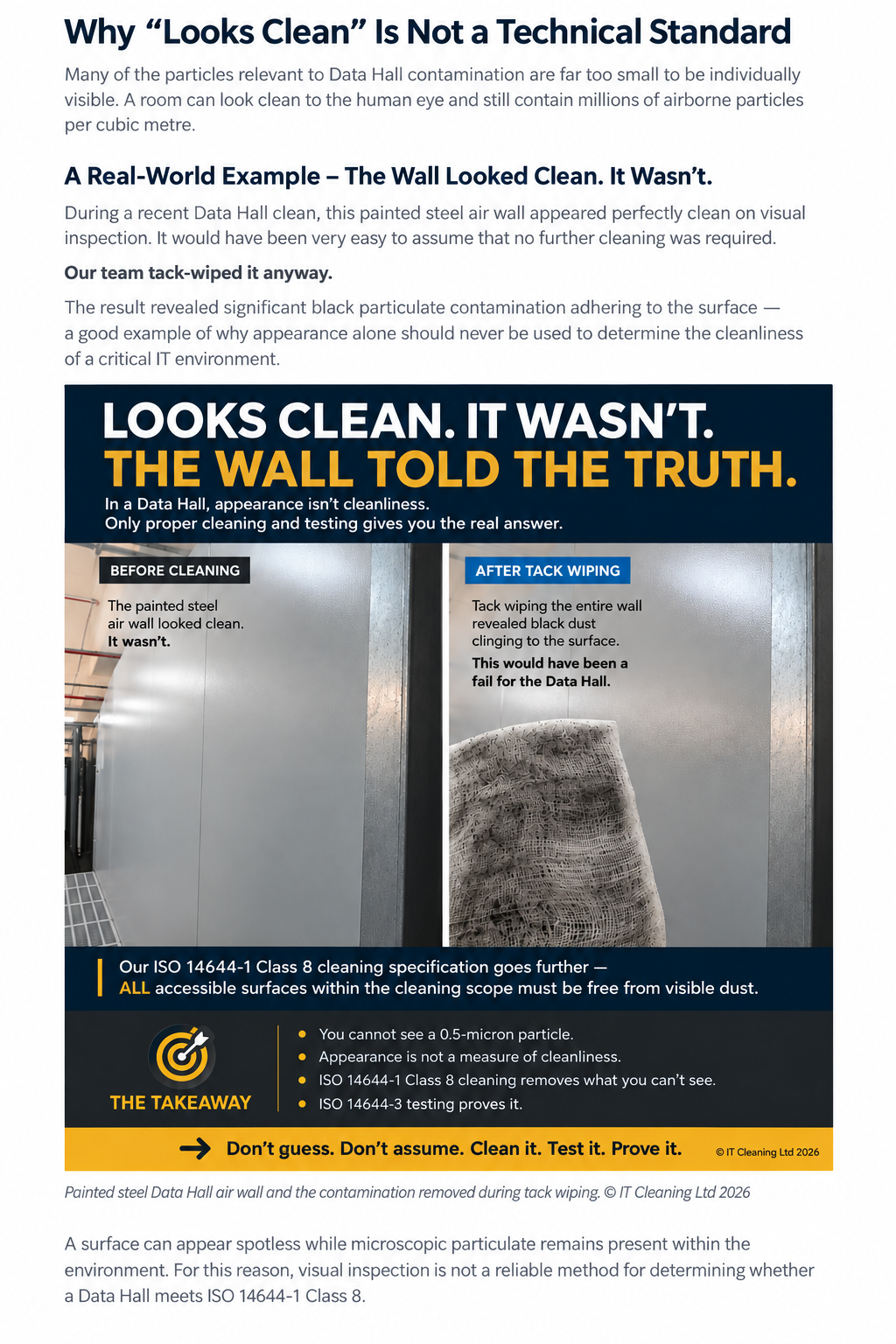 A surface can appear spotless while microscopic particulate remains present within the environment. Conversely, airborne particles can eventually settle onto equipment and surfaces before being disturbed again by personnel movement, maintenance or cooling airflow.
Visual inspection remains useful, particularly for identifying contamination sources and poor housekeeping.
But it cannot replace particle measurement.
You cannot determine ISO 14644 classification by looking at the room.
ISO 14644 Class 8 Data Centre Cleaning provides Data Centre operators with a measurable benchmark rather than relying solely on visual cleanliness.
ISO 14644 Class 8 Cleaning: Airborne Particles and Surface Contamination
ISO 14644-1 classification measures airborne particle concentration.
It does not certify that every surface within a Data Hall is free from deposited dust.
This distinction is important.
A Data Hall could potentially meet an airborne classification while still containing contamination on cabinet tops, cable trays or other surfaces capable of being disturbed later.
For this reason, IT Cleaning Ltd recommends combining ISO 14644-1 Class 8 airborne cleanliness with a wider technical cleaning objective:
All accessible surfaces free from visible dust and contamination.
This provides a more comprehensive contamination-control approach than airborne classification alone.
Why This Is Becoming More Important
Data Centre infrastructure continues to increase in density.
High-performance computing, AI infrastructure and increasingly powerful servers place substantial demands on cooling systems and equipment airflow.
As rack densities increase, effective heat removal becomes progressively more important.
OEMs (Original Equipment Manufacturers), including NVIDIA, specify ISO 14644-1 Class 8 environmental cleanliness requirements for certain data centre equipment
Contamination that interferes with airflow or deposits on cooling surfaces is therefore increasingly undesirable.
At the same time, modern Data Centres are being asked to demonstrate stronger operational controls, documented maintenance and measurable environmental performance.
A defined cleaning specification followed by particle testing provides evidence that contamination has been actively managed.
ISO Class 8 Cleaning Creates a Repeatable Benchmark
One of the major advantages of specifying ISO 14644-1 Class 8 is consistency.
Instead of asking:
“Is the Data Hall clean?”
the organisation can ask:
“Does the Data Hall meet the defined airborne particle concentration?”
That benchmark can then be incorporated into:
- Planned preventative maintenance
- Annual cleaning programmes
- Post-construction handover
- Data Hall refurbishment
- Contractor management
- Contamination investigations
- Environmental monitoring
- Operational risk management
Historical particle-count data can also help identify changes in environmental conditions over time.
When Should a Data Hall Be Cleaned and Tested?
The appropriate frequency depends on the facility, activity levels and contamination risk.
However, cleaning and particle testing should particularly be considered:
- Following construction or refurbishment
- After significant cabling works
- Following equipment installation programmes
- Where visible contamination is identified
- Following contamination incidents
- Where cooling equipment is generating particulate
- Before or after major infrastructure upgrades
- As part of a planned contamination-control programme
Facilities with high levels of contractor activity may require more frequent intervention than highly controlled environments.
The cleaning frequency should therefore be risk-based rather than arbitrary.
From Housekeeping to Contamination Control
The key difference is mindset.
Data Hall cleaning should not be viewed simply as an enhanced janitorial service.
In a critical IT environment, it forms part of the wider contamination-control strategy.
Professional technical cleaning should:
Remove deposited contamination.
Reduce sources capable of becoming airborne.
Protect live IT equipment during the cleaning process.
Provide measurable evidence of airborne cleanliness.
ISO 14644-1 Class 8 provides a recognised framework against which that final objective can be assessed.
Conclusion
Dust inside a Data Hall is more than a cosmetic issue.
Modern IT equipment continuously draws Data Hall air through sensitive electronic and cooling components. Whatever is present within that airflow has the potential to enter the equipment.
Professional cleaning therefore needs to go beyond making the room look clean.
A properly managed programme should combine specialist technical cleaning, contamination-source identification and airborne particle testing.
ISO 14644-1 Class 8 provides something visual inspection cannot:
a measurable definition of airborne cleanliness.
For Data Centre operators responsible for increasingly valuable, dense and business-critical infrastructure, that turns Data Hall cleaning from subjective housekeeping into a documented contamination-control process.
IT Cleaning Ltd – Specialist Data Centre Cleaning
IT Cleaning Ltd has specialised in cleaning critical IT environments since 2002.
Our Data Hall cleaning programmes can include specialist cleaning of accessible surfaces, raised-floor voids, cabinets and technical areas, followed by airborne particle testing against ISO 14644-1 Class 8 requirements.
The objective is straightforward:
Remove the contamination you can see. Measure the contamination you cannot.
For advice on Data Hall cleaning, contamination surveys or ISO 14644-1 Class 8 cleaning and testing, contact IT Cleaning Ltd.